Trade schools or vocational schools typically take up to two years to complete, so you can get a certificate in half the time it takes for a four-year college degree.
The image below provides a quick summary of popular programs that take less than 2 years.
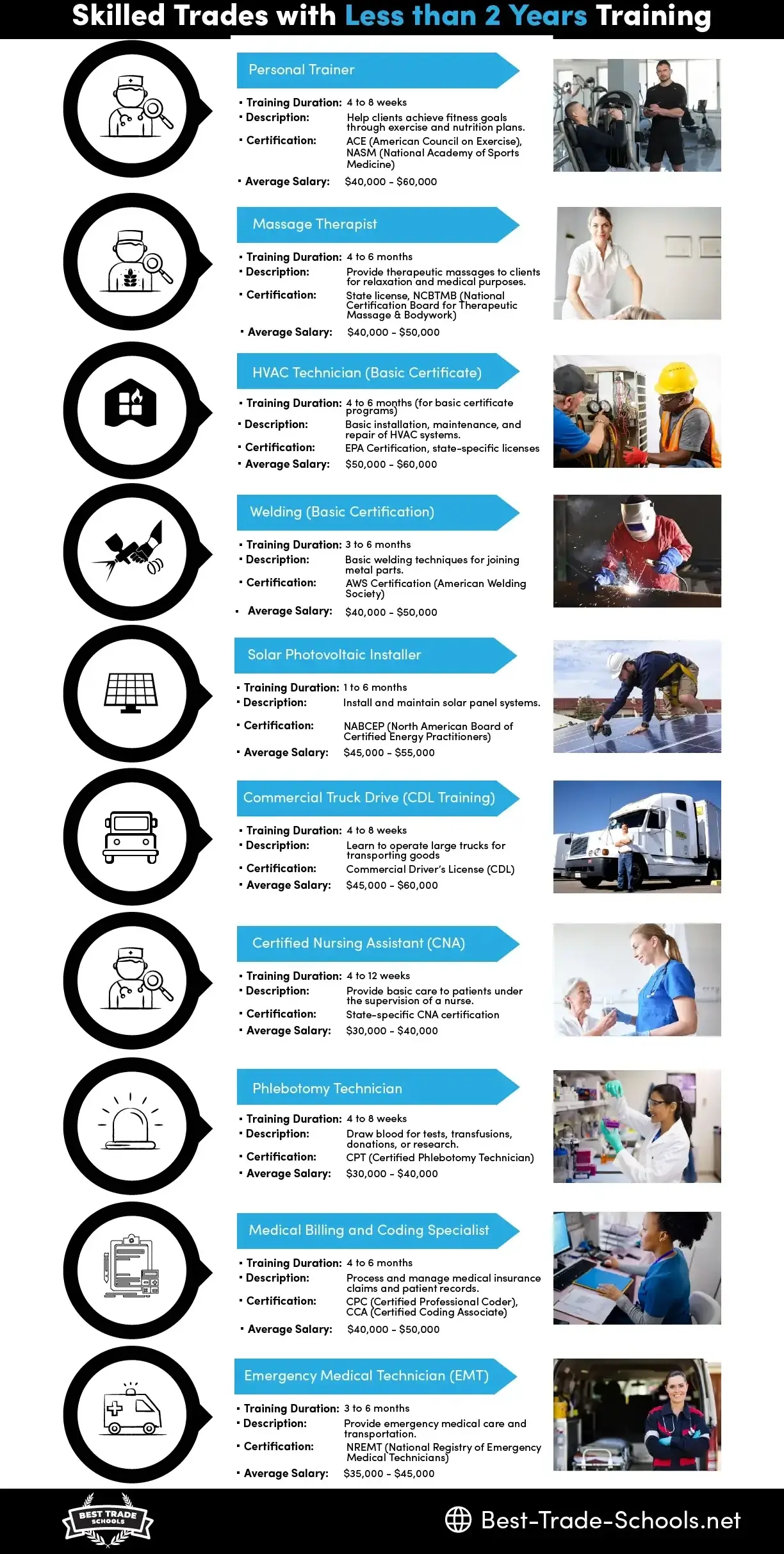
Trade schools, as a whole, offer a swifter route to entering the workforce when compared to the traditional four-year degree path.
This efficiency appeals to individuals who seek a quicker transition into the job market while acquiring valuable, job-specific skills.
Fastest Routes to Completion in Trade Schools
Here are some ways to fast-track your trade school journey and start working faster.
Accelerated Programs
Accelerated programs in some types of trade schools offer a fast track by condensing the conventional college or four-year colleges and training timeline.
Most programs offer a streamlined curriculum, intensive learning, shorter duration, full-time commitment, and cost efficiency.
These are ideal for those seeking to enter the workforce quickly, allowing them to start their careers sooner than most colleges would normally allow.
Accelerated programs prioritize hands-on training and skill development, making graduates highly employable upon graduation.
For example, in healthcare, Accelerated Bachelor of Science in Nursing (ABSN) programs offer a similar time advantage for students who already hold college credits or a non-nursing bachelor’s degree. Many ABSN programs can be completed in 12 to 18 months, combining online coursework, hands-on labs, and clinical rotations.
Like trade schools, ABSN programs emphasize practical training and rapid career entry, but they lead to a bachelor’s degree and RN licensure rather than a certificate or diploma.
Online Trade Schools
Online trade schools offer a flexible and accessible route to vocational education and career readiness.
These trade schools provide a wide range of programs and courses designed to teach students specialized skills and industry-specific knowledge from the convenience of their homes.
The best online schools enable students from various locations to access high-quality vocational education.
Part-Time vs Full-Time Programs
Unlike a traditional college, there are types of trade schools that offer part-time and full-time programs for vocational education, each offering unique advantages and considerations.
Full-time programs offer accelerated completion and intensive learning.
Part-time programs cater to busy schedules, allowing students to maintain a balanced lifestyle by accommodating work, family, and educational responsibilities.
They can also reduce financial burden, reduce stress, and allow for skill development over time.
Factors Influencing Program Duration
The duration of most trade school programs is influenced by various factors. The following section will discuss factors affecting your trade school stay.
Type of Program
The specific program or field of study you choose significantly determines program duration. Short-term trade schools programs, such as medical assisting or welding, typically last a few months to a year.
Program Complexity
The complexity of the skills and knowledge required for a particular profession can influence program duration.
More complex fields like healthcare or engineering often have longer programs to ensure students learn all the prerequisite skills more thoroughly.
Licensure or Certification Requirements
Some professions require individuals to obtain licenses or certifications to practice legally.
Meeting these requirements may extend the duration of the program as students must fulfill additional educational and testing criteria.
Credit Hours
Programs may be structured based on the credit hours required for graduation.
Longer programs often have a higher credit-hour requirement due to the depth of the curriculum.
Clinical or Practical Training
Programs that involve extensive clinical or practical training, like healthcare or the culinary arts, typically have longer durations to ensure students learn and gain the necessary hands-on experience.
What Are the Shortest Trade School Programs?
Short trade schools, often lasting a few weeks to a few months, offer focused training in trades such as:
- welding
- phlebotomy
- computer support
- EMT
- CNA
- CDL
- bartending
What Are the Longest Trade School Programs?
Some of the longest trade school programs, like those for HVAC technicians, can extend up to 2 years or more.
The duration of these programs is influenced by the extensive training they provide. The complexity of the skills taught in a specific trade also plays a role; more intricate or specialized trades may necessitate a more extended training period.
HVAC
HVAC programs encompass a broad curriculum, covering complex topics like electrical systems, refrigeration, heating and cooling systems, ductwork design, and stringent safety protocols.
The extended duration ensures that graduates can handle the diverse challenges and responsibilities that come with an HVAC technician’s career.
Electrician
Electrician trade school programs, found in most trade schools, typically take about 2 years to complete before people become licensed electricians.
People learn the fundamentals of electrical systems, safety protocols, and practical installation and maintenance techniques.
However, this is still a relatively short time frame, compared to traditional four-year degrees.
Associate Degrees
One determinant of duration is whether the program leads to an associate degree, as these courses may take longer due to additional coursework and academic requirements.
Apprenticeship
Another notable aspect that affects program length is whether there’s an included apprenticeship program. During these, individuals receive on-the-job training alongside experienced professionals, honing their skills and applying what they’ve learned.
Conclusion
Trade school programs offer a diverse range of educational opportunities, each tailored to specific goals and timelines.
From programs that can be completed in a matter of weeks to those spanning a few months or even up to two years, trade schools provide a flexible and efficient path to gainful employment.
It’s crucial to understand the duration of these programs and their potential to fast-track your entry into the workforce.
Whether you’re a recent high school graduate, a career changer, or someone seeking to enhance your skills, trade schools offer a practical and valuable opportunity.
As you contemplate your educational and career journey, consider exploring trade schools as a viable option to achieve your goals efficiently and embark on a fulfilling career.