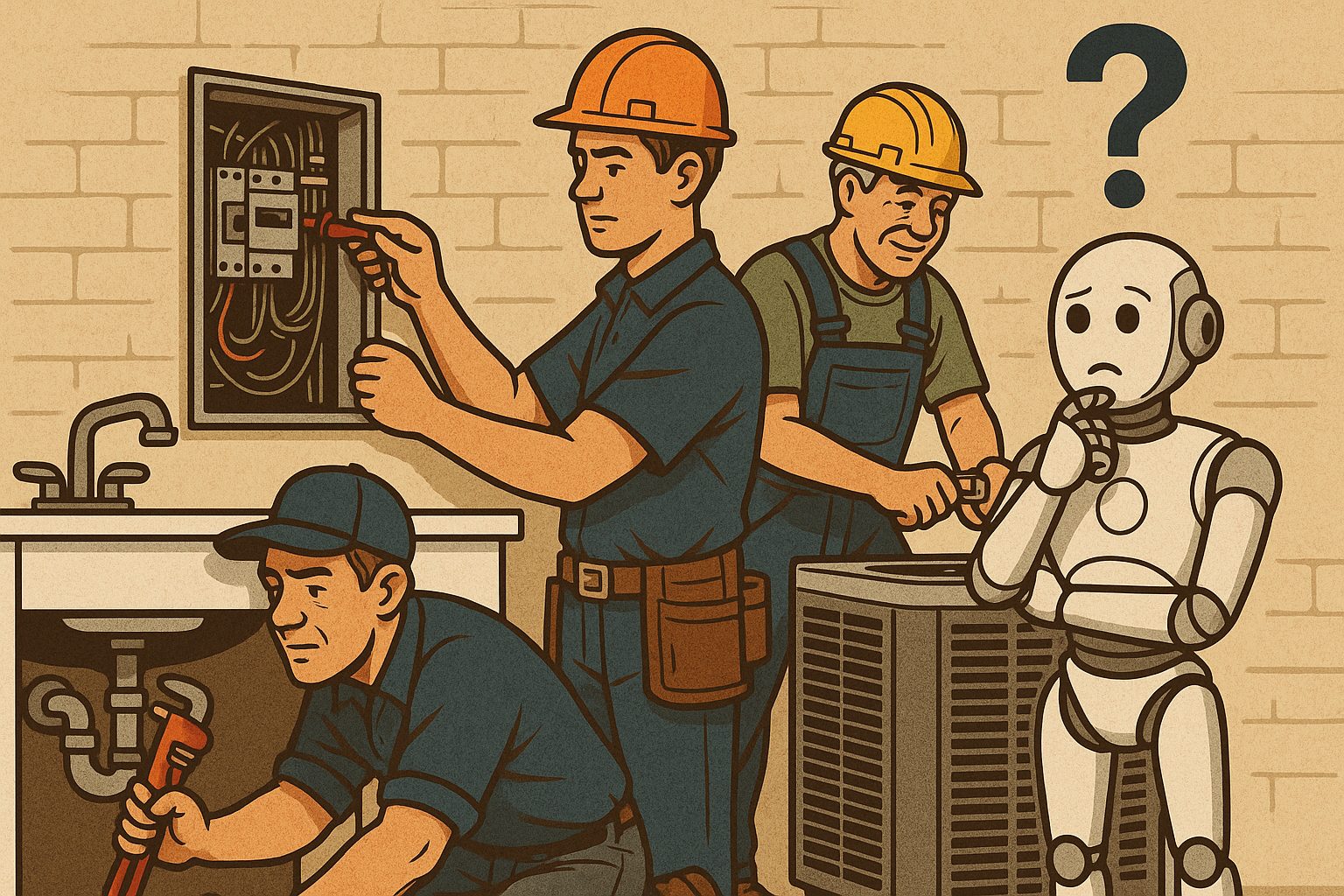
Everyone is talking about AI taking jobs. In some areas, it already has—data entry, customer service, the kind of repetitive work that follows a script. A computer can do that faster and cheaper.
But that is not the whole story. Plenty of jobs are still stubbornly human. A plumber crawling under a house to find a leak. An electrician tracing wires in an old building where the lights keep flickering. These are jobs rooted in the real world, where conditions are messy and unpredictable. No machine is ready for that.

Why the Trades Are Safer from Automation
AI thrives on patterns and consistency. It works best when there is a clear set of rules—like sorting packages or filling spreadsheets.
Job sites rarely work that way. Every house, every system, every client brings something unique. A robot cannot pause to consider a customer’s explanation or adapt to the quirks of a century-old building.
That is why the trades stand out as careers with staying power.
The Trade Jobs That Will Outlast the Robots
Electricians
Electricians make solid money—about $62,350 a year on average—and demand is expected to grow 9% through 2034. Their work is hands-on, sometimes dangerous, and always changing. No AI is climbing into an attic with live wires anytime soon.
Plumbers
Plumbers do more than fix leaks. They build entire water systems. The median wage is about $60,040, with steady demand and a growth outlook of 9% by 2030. The work is unpredictable, often messy, and always in demand. AI simply isn’t suited for this type of work.
HVAC Technicians
Heating, cooling, ventilation—every building depends on these systems. HVAC technicians earn about $57,300 a year, and job growth is projected to stay strong. Every system is different, which makes this work tough to automate. AI doesn’t have the dexterity needed to solve the real-world problem encountered every day by HVAC techs.
Automotive Technicians
Cars are smarter than ever, but they still break in ways that require a human to figure out. Automotive techs use computers to diagnose issues, but repairs come down to skill and judgment. Average pay sits around $47,770. AI might have a leg-up on diagnostics, and perhaps even be able to plug in to your car to find the problem, but finesse to execute the repair is well beyond the reach of AI for now.
Elevator Installers and Repairers
These workers earn some of the highest wages in the trades—around $102,420 a year—and demand remains steady. The work is precise, physical, and often risky. No machine is taking over when it comes to moving people safely through skyscrapers. This type of work is typically certified. It will be a while before such privilege is delegated to AI.
What People in the Field Are Saying
“We’ve been telling kids for 15 years to learn to code. AI is coming for the coders. They are not coming for the welders. They are not coming for the plumbers. They are not coming for the electricians.” Axios
A veteran electrician put it even more plainly on a forum: “I have zero fear of being replaced by AI. Maybe by someone younger and smarter, but not a robot.” Job security is certainly a factor of today’s trade careers.
Why Trade Schools Still Matter
Trade schools are not just about learning how to use tools. They teach you how to adapt when things go wrong, solve problems on the fly, and work safely in high-pressure situations. These are skills AI cannot learn the way people can.
If you are curious, the best first step is visiting a local trade school. Talk to instructors. Ask students about their experience. See the training for yourself.
Final Thought
AI is changing the world quickly, but it is not going to fix your furnace in the middle of January. If you want steady work, good pay, and the satisfaction of solving real problems in real time, the trades are worth a serious look.